

Montessori Education in the Early Years: A Parent’s Guide
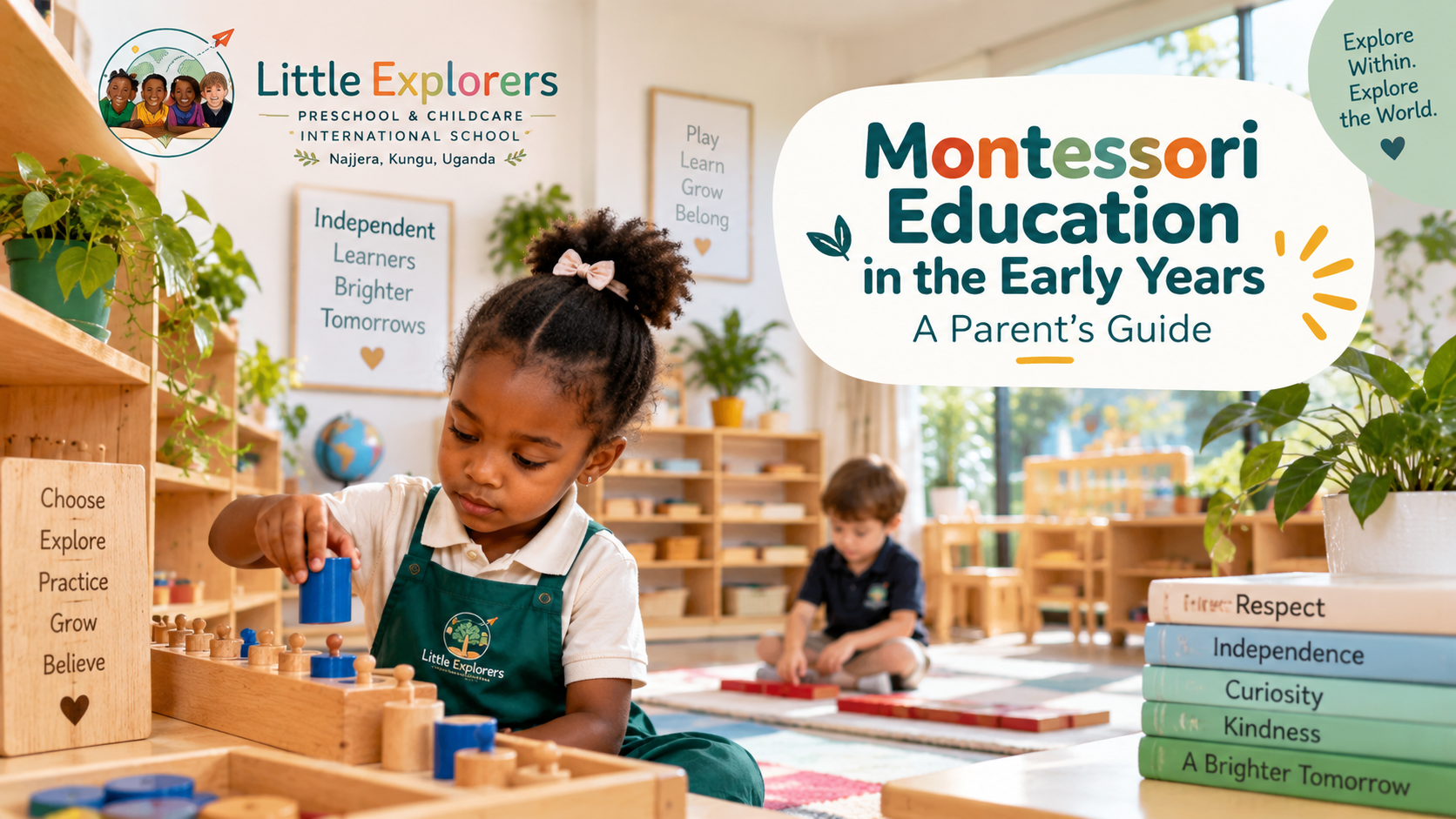
What is Montessori education and how does it work in the early years? Explore independence, hands-on learning, practical life and what parents should look for in a preschool.
Choosing an early years programme often introduces parents to different approaches to learning. One of the most recognised is Montessori education.
You may see terms such as Montessori preschool, Montessori classroom or Montessori-inspired learning when comparing early years schools. But what do these terms actually mean, and what should parents look for beyond the label?
This guide explains the main ideas behind Montessori education, how they can support young children, and what parents should consider when choosing an early years environment in Uganda.
What Is Montessori Education?
Montessori education originated from the work of Italian physician and educator Maria Montessori. The approach places strong emphasis on children's independence, purposeful activity and learning through direct experience.
Instead of expecting every child to complete exactly the same activity at the same moment, Montessori environments traditionally allow children to work with carefully selected materials and develop skills progressively with guidance from adults.
For young children, this can mean learning through practical tasks, sensory exploration, language activities, early mathematics and everyday experiences.
The goal is not simply to teach children information.
It is to help them become curious, capable and increasingly independent learners.
What Does a Montessori Learning Environment Look Like?
A Montessori-style classroom can feel different from a conventional classroom.
Materials are usually organised so children can see and access them. Furniture and learning spaces are designed around children's size and abilities, encouraging them to participate more independently.
You might see children choosing an activity, carrying it to a workspace, concentrating on it and returning it when they finish.
The environment itself becomes part of the learning experience.
A well-designed early years environment should encourage children to explore while still providing clear routines, boundaries and adult guidance.
1. Independence Is Encouraged From an Early Age
Independence is one of the ideas most commonly associated with Montessori education.
For a young child, independence does not mean being left alone.
It means gradually learning to do appropriate things for themselves.
That might include choosing a learning activity, putting materials away, washing hands, helping prepare a snack, carrying belongings or completing a simple practical task.
These everyday experiences can help children develop confidence and responsibility.
Small tasks can create a powerful message:
“I can try this myself.”
2. Children Learn Through Hands-On Experiences
Young children naturally learn by touching, moving, experimenting and repeating.
Montessori learning materials are designed to give children opportunities to explore concepts physically rather than relying only on verbal explanations.
For example, children might sort objects by size, match shapes, count physical objects, pour water between containers or use tactile materials to explore letters and sounds.
Hands-on learning can turn an abstract idea into something a child can experience directly.
This is particularly valuable during the early years, when children are developing foundational cognitive, physical, language and social skills.
3. Children Are Given Time to Concentrate
Young children can develop surprisingly deep concentration when they are genuinely interested in an activity.
A Montessori-inspired environment tries to protect that concentration rather than interrupting children unnecessarily.
When a child repeats the same activity several times, it may look simple to an adult.
But repetition can be an important part of learning.
The child may be developing coordination, problem-solving ability, memory, patience or confidence with every attempt.
This is one reason parents should look beyond how many activities a preschool offers and consider how children are allowed to engage with them.
4. The Teacher Acts as a Guide
In Montessori education, the adult's role is not simply to stand in front of the classroom and deliver information.
Teachers observe children, introduce appropriate activities and provide support when needed.
Sometimes that means demonstrating something carefully.
Sometimes it means asking a question.
And sometimes it means recognising that a child is concentrating successfully and allowing them to continue without unnecessary interruption.
The relationship between teacher, child and environment is therefore an important part of the approach.
5. Practical Life Activities Matter
One distinctive element of Montessori education is the importance given to practical life.
Activities that adults consider ordinary can be valuable learning opportunities for children.
Pouring, carrying, sorting, cleaning, fastening clothing or caring for classroom materials can support coordination and independence.
They can also teach children that they are active members of their environment rather than passive recipients of adult help.
These experiences can gradually build responsibility and confidence.
6. Learning Can Follow the Child’s Development
Children do not all develop at exactly the same speed.
One child may become fascinated by letters while another is deeply interested in construction, movement or sorting.
A child-centred early years environment recognises these differences while still providing purposeful developmental opportunities.
Teachers can observe what children are ready for and introduce experiences that provide an appropriate next challenge.
That does not mean there are no expectations or structure.
It means learning is responsive to the child's developmental stage rather than being based entirely on a rigid timetable.
7. Social and Emotional Development Still Matters
Montessori education is sometimes associated mainly with individual activities, but early childhood development involves much more than academic learning.
Children are also learning how to communicate, wait, cooperate, express emotions, solve disagreements and participate in a community.
Uganda's current Early Childhood Care and Education framework recognises socio-emotional development alongside foundational pre-literacy and pre-numeracy competencies as important aspects of children's development.
A strong early years programme should therefore support the whole child, not simply early academic skills.
Montessori vs Montessori-Inspired: Is There a Difference?
Yes.
Parents may encounter both Montessori schools and programmes described as Montessori-inspired.
A Montessori school may follow a more formal interpretation of Montessori principles, potentially including specific materials, classroom structures and teacher training.
A Montessori-inspired programme may incorporate selected principles—such as independence, practical life, hands-on learning and child-accessible environments—while combining them with other early childhood approaches.
Neither label alone tells parents whether a programme is right for their child.
The more useful question is:
What actually happens in the classroom every day?
Questions to Ask When Visiting a Montessori Preschool
Rather than choosing a school simply because the word “Montessori” appears in its name or marketing, visit and observe the environment.
Useful questions include:
How is independence encouraged?
What role do teachers play during learning activities?
How do children choose and use materials?
How much uninterrupted time do children have for purposeful activities?
How are language and early numeracy supported?
How does the programme support social and emotional development?
How are children supported when they need additional guidance?
How does the school communicate children's progress to parents?
Also watch the children.
Are they engaged?
Do they seem comfortable asking adults for help?
Can they access materials independently?
Are teachers interacting warmly and respectfully with them?
Those observations can tell you more than a brochure.
Is Montessori Education Right for Every Child?
No single educational approach is automatically the best choice for every child or every family.
Some parents are particularly attracted to Montessori principles because they value independence, concentration and hands-on learning.
Others may prefer programmes that combine these ideas with different approaches to creativity, collaborative play, movement and teacher-led experiences.
What matters most is finding an environment where your child feels safe, supported, curious and confident enough to explore.
Montessori-Inspired Learning at Little Explorers
At Little Explorers in Najjera, Kungu, our approach incorporates purposeful, hands-on experiences that encourage children to become increasingly confident and independent.
Children are given opportunities to explore, make choices, practise practical skills, communicate with others and develop through meaningful everyday experiences.
Rather than focusing only on what children know, we care about the capabilities they are developing along the way—from curiosity and concentration to independence, communication and problem-solving.
Parents are encouraged to experience the learning environment themselves and see how these principles appear in everyday school life.
Frequently Asked Questions
What age is best to start Montessori education?
Montessori principles can be introduced during the early years. The appropriate programme depends on the child's developmental stage and the environment provided by the school rather than one universal starting age.
Is Montessori the same as preschool?
No. Preschool describes an early childhood education stage, while Montessori is an educational approach. A preschool may use Montessori methods, another educational philosophy, or a combination of approaches.
What do children learn in a Montessori preschool?
Children may engage with practical life, sensory activities, language, early mathematics, movement and other hands-on learning experiences while developing independence and concentration.
Does Montessori involve learning through play?
Montessori traditionally places particular emphasis on purposeful activities and hands-on learning materials. Other early years programmes may combine Montessori-inspired principles with broader forms of imaginative, creative and collaborative play.
How can I tell if a Montessori preschool is good?
Look beyond the name. Visit the school, observe teacher-child interactions, ask about teacher training and the learning approach, and examine whether children have access to purposeful, age-appropriate activities in a safe and supportive environment.
Little Explorers Team
Sharing insights on early learning, parenting and Ready at 6.